

Weather and Climate
Summary and Forecast
October 2026 Report
Gregory V. Jones, Ph.D.
October 4, 2026
Summary:
- October temperatures in September, and now, September temperatures in October, over most of the West!
- Cooler than average* for most of the PNW and most of California, while the Southwest, Rockies, Front Range, and Plains saw warmer than average temperatures during September.
- September saw high pressure areas shifting out over the Pacific and eastward to the Plains, allowing low pressure areas to move southward along the West Coast, bringing above average precipitation to much of Northern California and PNW, while monsoon flow kept the Southwest and Four Corners wetter than average.
- The drought footprint remains high across the West, with the forecast pointing to the PNW and northern states remaining on the dry side, while California and the southern states are likely to see drought conditions lowered or removed altogether.
- Unseasonably warm over most of the western US over the next ten days or so, with no rain in the forecast.
- October looks like it will be relatively dry and warm for most of the western US. Only rain on the horizon is for later in the month and then mostly in the far northern parts of the PNW or with monsoon moisture in the Southwest.
- A strong El Niño in the tropical Pacific is shaping the seasonal Over the next 90 days, warmer than average conditions are favored across much of the country, with wetter than average conditions likely from southern California across the southern tier of states and drier than average conditions favored in the Pacific Northwest, Northern Rockies, Plains, and parts of the Great Lakes.
*Note that all references to normal or averages in this report are to the 1991-2020 climate normal for each weather/climate parameter unless stated otherwise. See this website for more information on climate normals.
For a PDF of this report, click here.
Past Month and Year to Date:
Wasn’t October wonderful? I say this because the month of September was, on average, just like a typical October for most of the western US. Temperatures were 1-5 degrees below average for most locations in Oregon, Washington, and most of California, while the Southwest, Rockies, and Plains were warmer than average (Figure 1). The cooler month was caused by shifts in our normal high pressure zones further to the west over the North Pacific and further to the east over the Southern Plains, which allowed a corridor of cooler air associated with low pressure areas to slide south along and into the West Coast. While the west was cool, the rest of the country was much warmer than normal, with the Southern Plains, Texas, and southern Mississippi River valley running as much as 5-15 degrees warmer than normal (not shown).
September brought mostly wetter than average conditions over the West, especially north and south of Central California and Nevada, where little to no precipitation was recorded (Figure 1). The Southwest continued to receive subtropical flow and monsoon rains, some associated with tropical cyclones recurving onto Mexico and moving northeasterly into the US. The monsoon flow helped to produce the dominant storm track during the month, with moisture moving into the Plains and getting entrained into low pressure areas to the north. The result was severe weather and heavy rains across the Corn Belt and into the Ohio River Valley with over 300% of average and some locations seeing the wettest September on record (not shown). The Southeast was overall quite dry during the month.
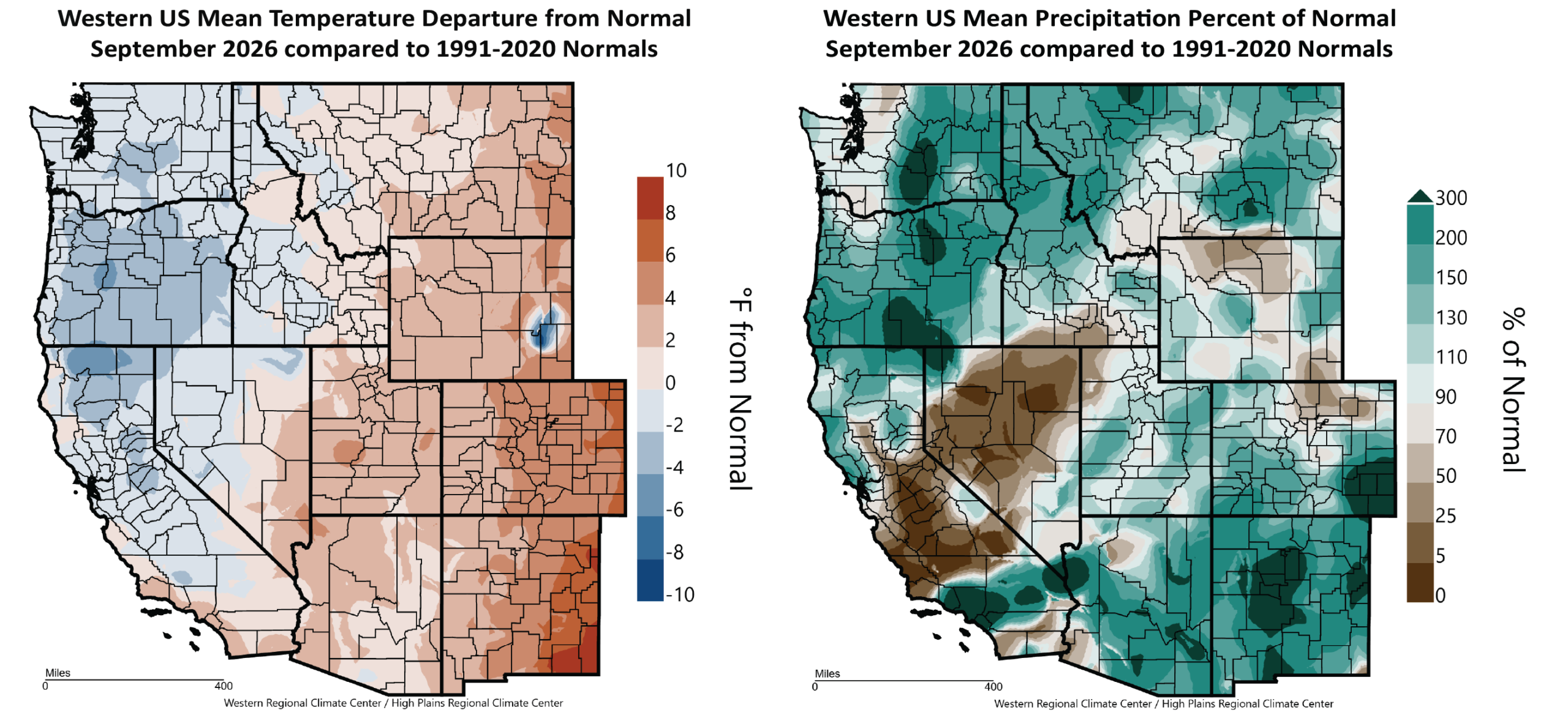
Figure 1 – Western US September 2026 temperature departure from normal (left) and percent of normal precipitation (right; images from WestWide Drought Tracker, Western Region Climate Center; University of Idaho).
While September lowered the year-to-date temperature average for portions of the PNW, the overall pattern continues warmer than average for most locations (Figure 1). The warmest regions continue to be the southwest, portions of the Great Basin, and most of the Rockies, with temperatures 4-8 degrees warmer than average for the first nine months of the year. California has been warm as well, more so in the southern half of the state, with temperatures 2-4 degrees above average and much higher dew point temperatures (humidity) compared to average. Western Oregon and Washington have experienced closer to normal temperatures year-to-date (+0.5-2 degrees). The rest of the country has seen warmer-than-average temperatures since the first of the year, running 4-6 degrees above average in Texas and the Southern Plains, and 2-4 degrees warmer than average in the Mississippi River Valley to the Great Lakes. The Southeast and eastern seaboard have experienced closer to average year to date conditions (0.5-2 degrees; not shown).
For the first nine months of the year, precipitation amounts over the western US have been mostly drier than normal (Figure 2), although isolated areas in northwestern Nevada and southcentral Oregon, the northern Rockies, southern Arizona, and New Mexico have been wetter than normal, most of which is due to an active monsoon flow this summer. The January through September period has also seen drier than average conditions in the central to northern Plains, the Southeast, and Florida (not shown), while portions of Texas, the Gulf Coast, the Corn Belt, the Ohio River valley, and the Great Lakes have experienced roughly 150-300% of average precipitation.
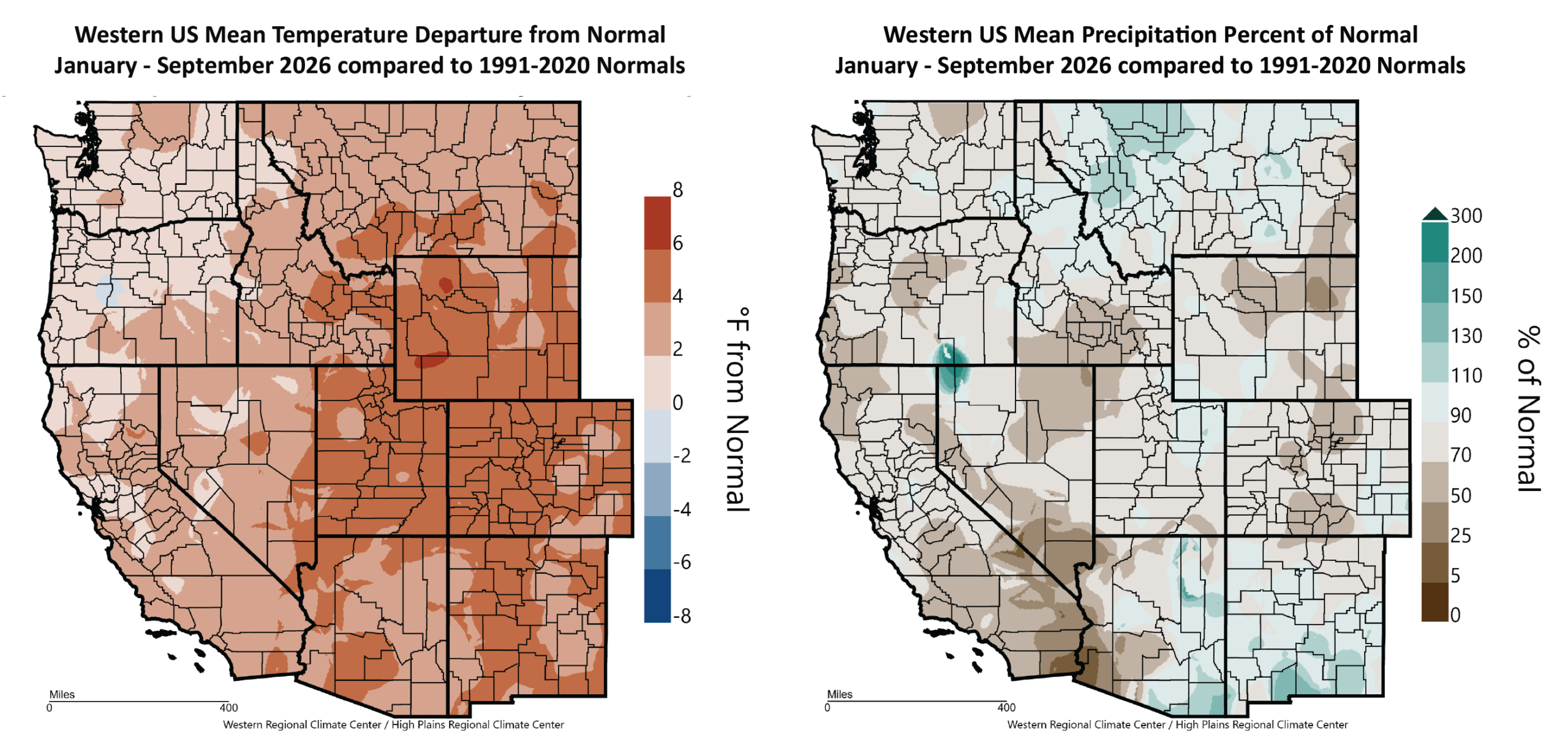
Figure 2 – Western US year to date (January through September 2026) temperature departure from normal (left) and percent of normal precipitation (right; images from WestWide Drought Tracker, Western Region Climate Center; University of Idaho).
Heat Accumulation:
March through September growing degree-days (GDDs) over the western US are mostly above average (Figure 3). Warmer conditions in Central to Southern California and the Southwest have resulted in GDD mostly from 300 to 600 units above average. Some coastal zones in California, most of the PNW, and across the Northern Rockies have seen lower GDD departures, with values mostly 100-300 GDD above average. There remain numerous areas along the entire West Coast with GDD amounts closer to average or just slightly below average. These areas include coastal zones and the Cascades of Oregon, portions of eastern Oregon, the Columbia and Yakima Valley areas of Oregon and Washington, and much of Northern California.
For the four main regions in Oregon (the Willamette Valley, Umpqua Valley, Rogue Valley, and Walla Walla Valley), a cool September slowed heat accumulation for the vintage to date; however, each location continues to show above average GDD values. By the end of September, the four locations were 9-21% above average compared to the 1981-2010 climate normals and slightly below (-2% Milton-Freewater) to 4-11% above average for the 1991-2020 climate normals. The cool September resulted in all four locations moving to their average GDD observed over the last 20 years. Each location is also now below its GDD accumulation at the same point in 2025, with Medford at 11% below, Roseburg at 13% below, Milton-Freewater at 10% below, and McMinnville at 7% below 2025 values.
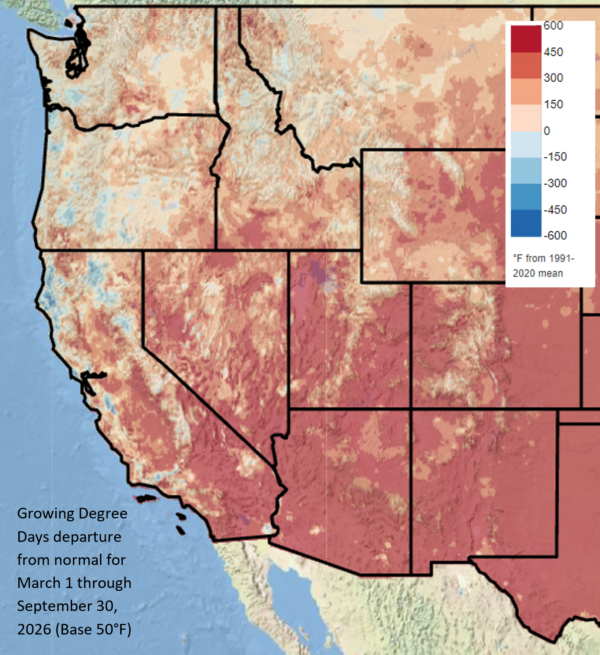
Figure 3 – Western US March through September 2026 growing degree-days (image from Climate Impacts Research Consortium, University of Idaho).
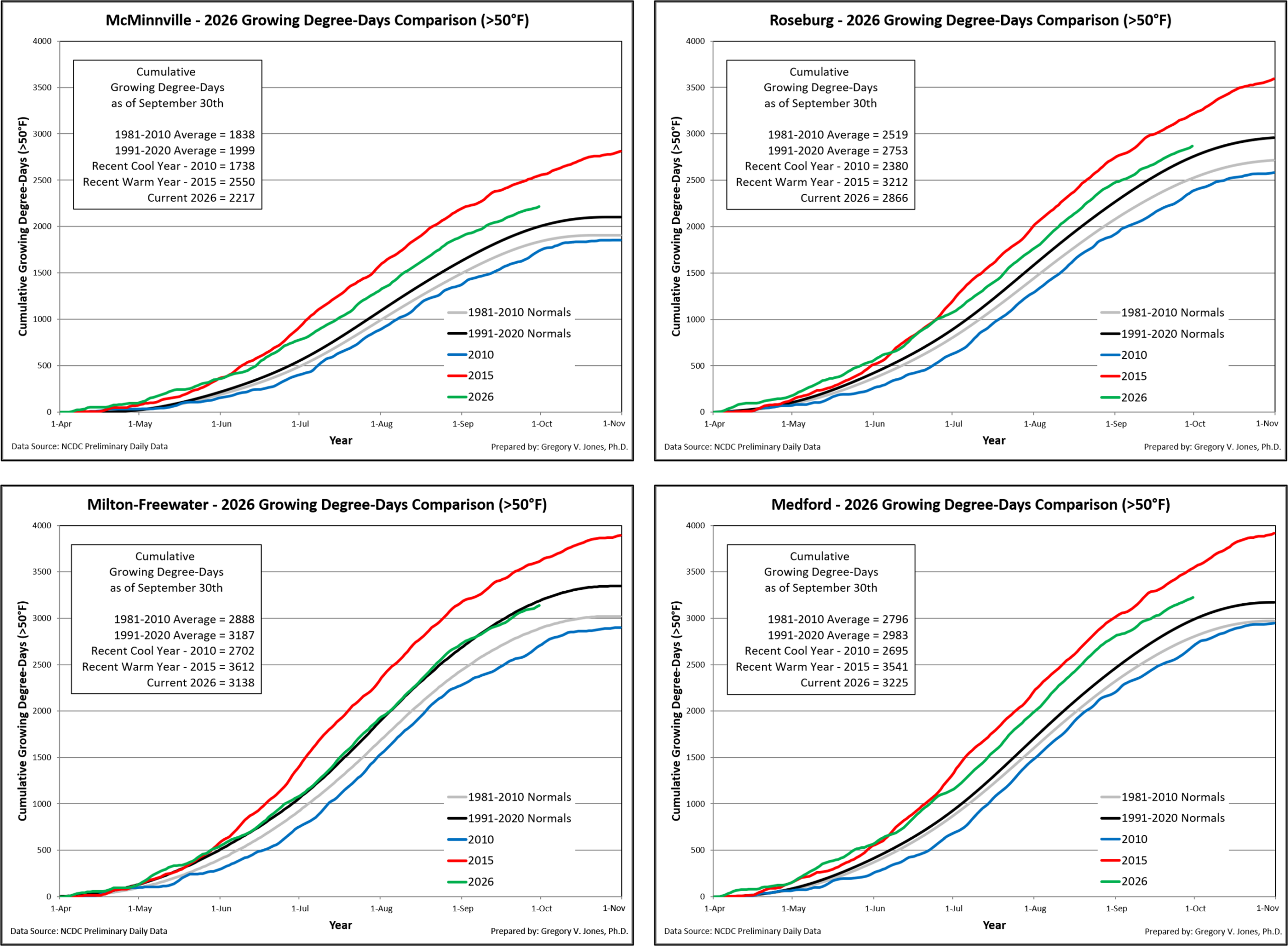
Figure 4 – Cumulative growing degree-days (base 50°F, no upper cut-off) for McMinnville, Roseburg, Milton-Freewater, and Medford, Oregon. Comparisons between the current year (2026) and a recent cool year (2010), a recent warm year (2015), and both the 1981-2010 and 1991-2020 climate normals are shown (NCDC preliminary daily data).
Drought Watch:
The most recent Drought Monitor map release (Figure 5) came out just before tropical system flows into the Southwest and Southern Plains brought significant moisture to the region. Updates in a couple of weeks will show some significant recovery in those regions. But as of the end of the month, the overall drought footprint for the contiguous 48 states remained close to 79%, with the most extreme drought categories increasing slightly to nearly 34%. Relatively cool and wet conditions during September over the western US lowered the drought footprint 5% to just above 88%, with the most extreme categories dropping 7% to nearly 41% of the west. In September, California was wetter than average north and south, with drier than average conditions in the central portion of the state (Figure 1). The overall change in the drought footprint was a slight increase to just over 72% in experiencing some level of drought, but none of the state is currently in the more extreme categories of drought. The PNW was mostly wetter than average in September; however, the conditions did not lower drought concerns much. Oregon’s drought footprint remained close to 99% of the state, with the extreme drought categories (severe, extreme, and exceptional) dropping 10% to nearly 58% currently. Drought area remained the same in Washington over the last 30 days, with 94% of the state in some level of drought and the most extreme categories of drought staying near 25%. During September, Idaho and Montana were also wetter than average, seeing a greater reduction in drought with Montana’s overall drought footprint dropping from 93% to 61%, with the extreme categories also dropping to just over 13% of the state. Idaho’s overall drought footprint dropped from 97% to close to 86%, while the most extreme drought categories dropped 4% to over 53% of the state (Figure 5).
The seasonal drought outlook continues to show the effects of the anticipated subtropical inputs into the Southwest, Southern Rockies, Southern Plains, and Gulf Coast where improvement or removal from drought categories is likely (Figure 5; right panel). For the PNW and Northern Rockies, drought conditions are forecast to continue or develop further over the next three months. Over the Corn Belt and Ohio River Valley, the storm track over the last two months has left the region drought-free but has made harvesting corn and other field crops more difficult. Portions of the Northern Plains across to the western Great Lakes are forecast to remain in drought, while Northern New England and the mid-Atlantic are forecast to improve or become drought-free (Figure 5; right panel).
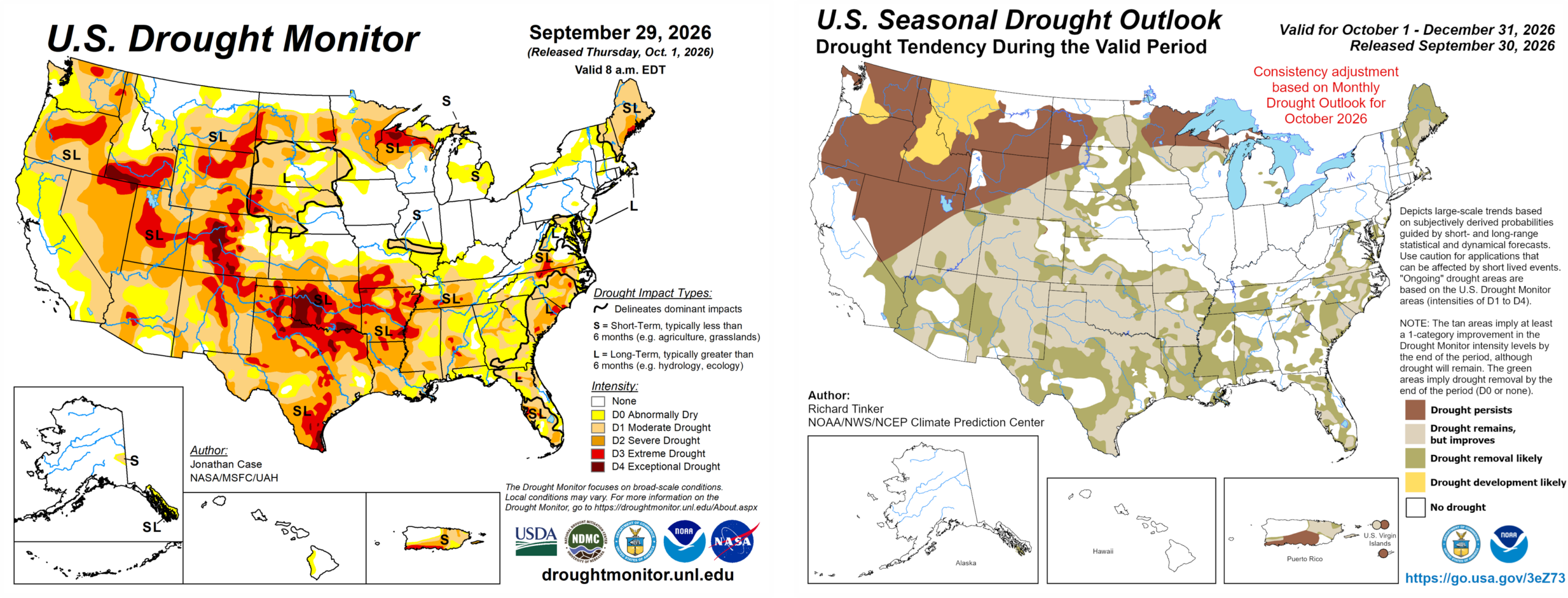
Figure 5 – Current US Drought Monitor and seasonal drought outlook.
ENSO Watch:
Sea surface temperatures in the tropical Pacific zone are now at an all-time record and in what most are calling super El Niño conditions (Figure 6). Atmospheric conditions across the Tropical Pacific also continue to be consistent with El Niño, producing numerous eastern Pacific tropical systems, enhancing the subtropical jet stream with significant monsoon flow into the Southwest, and putting a lid on Atlantic and Gulf hurricane activity. Multiple forecast models from North America and other Pacific Rim countries, along with the Climate Prediction Center, point to the likelihood that El Niño will continue strengthening through the end of the year. For the Northern Hemisphere fall and winter, the outlook has a greater than 90% chance that the event will remain a very strong event. El Niño-related impacts around the world are likely to be enhanced but are not guaranteed. In addition, impacts might be slow to develop or spatially not what we expect initially and are more likely to occur from December into the first few months of next year. Typical impacts include a warmer and drier PNW and northern states, while California and more southerly locations will likely see milder temperatures but significantly wetter conditions.
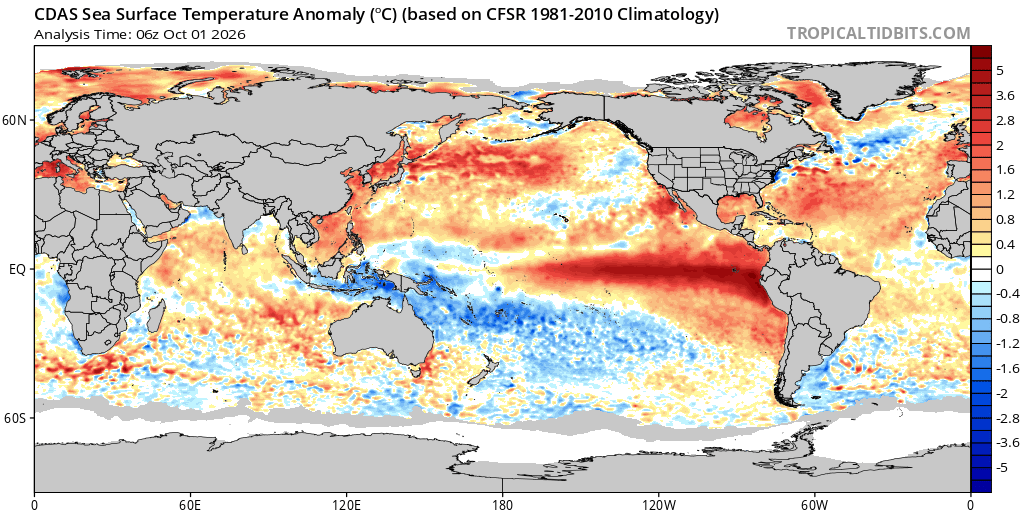
Figure 6 – Global sea surface temperatures (°C) for the period ending October 1, 2026 (image from Tropicaltibits.com).
North Pacific Watch:
The Gulf of Alaska warmed during September while the rest of the basin remains warmer than average. The horseshoe-shaped area of cooler SSTs from the Gulf of Alaska along the coast of western North America and southward to Hawaii, which contributes most to the Pacific Decadal Oscillation (PDO), has also warmed somewhat but remains cooler than average off the West Coast (Figure 6). The North Pacific remains in the negative phase of the PDO, but the warming over the last 45-60 days continues to bring the North and Tropical Pacific more ‘in phase’, which historically has brought more likely weather impacts over North America from a split jet stream. In most instances where the PDO and ENSO are in phase, the PNW experiences a drier and warmer fall/winter, while most of California and the southern tier of states see much higher precipitation amounts.
Forecast Periods:
Next 5 Days: High pressure builds over the West, bringing unseasonably warm and dry conditions. Heat advisories in California and temperatures likely 5-10 above average in Oregon, Washington, and across most of the Basin. No precipitation across most of the West, except maybe showers in far northwestern Washington and some remnants of subtropical moisture in the Southwest.
6-10 Day (valid October 8-12): High pressure continues to dominate the west with above average temperatures and very little, if there is any, precipitation. The eastern US gets a reprieve from the heat of the last few weeks, with subtropical moisture likely breaking some of the drought conditions in the Mid-South and Southeast.
8-14 Day (valid October 10-16): Moving into mid-month, models are still holding to warm and dry over the west due to high pressure remaining over the region. However, there is some indication of this being squeezed southward, allowing a front to move into the PNW or possibly over the northern Rockies. Not much precipitation likely, though. The South and Southeast are likely to see above average precipitation during this period with near normal amounts along the East Coast and New England.
30 Day (valid October 1-31): The prominence of the high pressure over the west during the first few weeks of October will likely result in a warmer than average month for most of the western US (Figure 7). The greatest chance for warmer than average temperatures is forecast for California, northern portions of the West, and Florida. Equal chances of below, near, or above-normal temperatures are forecast for most of Texas, across the South and Midwest, and into the Mid-Atlantic and New England, where a more variable temperature pattern is expected in October. The October precipitation outlook has much of the western US likely seeing below average amounts during the month, while the Gulf Coast and Southeast have a strong chance of seeing a wetter than average month (Figure 7).
90 Day (valid October-November-December): Lots of talk about the effects of El Niño heading further into fall and the start of winter. Currently, warmer than average temperatures are forecast for most of the country (Figure 7). The highest forecast confidence for above-normal temperatures over the next three months is centered over the PNW and across into the Northern Plains, with decent chances of warmer than average temperatures across the rest of the West, Eastern Seaboard, and Southeast. Equal chances of below, near, or above-normal temperatures are forecast for the Southwest, Texas, and Southern Plains, where a more variable temperature pattern is expected over the next 90 days. The 90 day precipitation forecast is largely pointing to equal chances of below average, near, or above average over portions of the US; however, there is high confidence in below average amounts likely in the northern Rockies and portions of the Great Lakes, while the subtropical jet stream is forecast to bring higher than average precipitation amounts to the southern tier of states from the Southwest, across the Southern Plains, the Gulf Coast, Southeast, and into the mid-Atlantic (Figure 7).
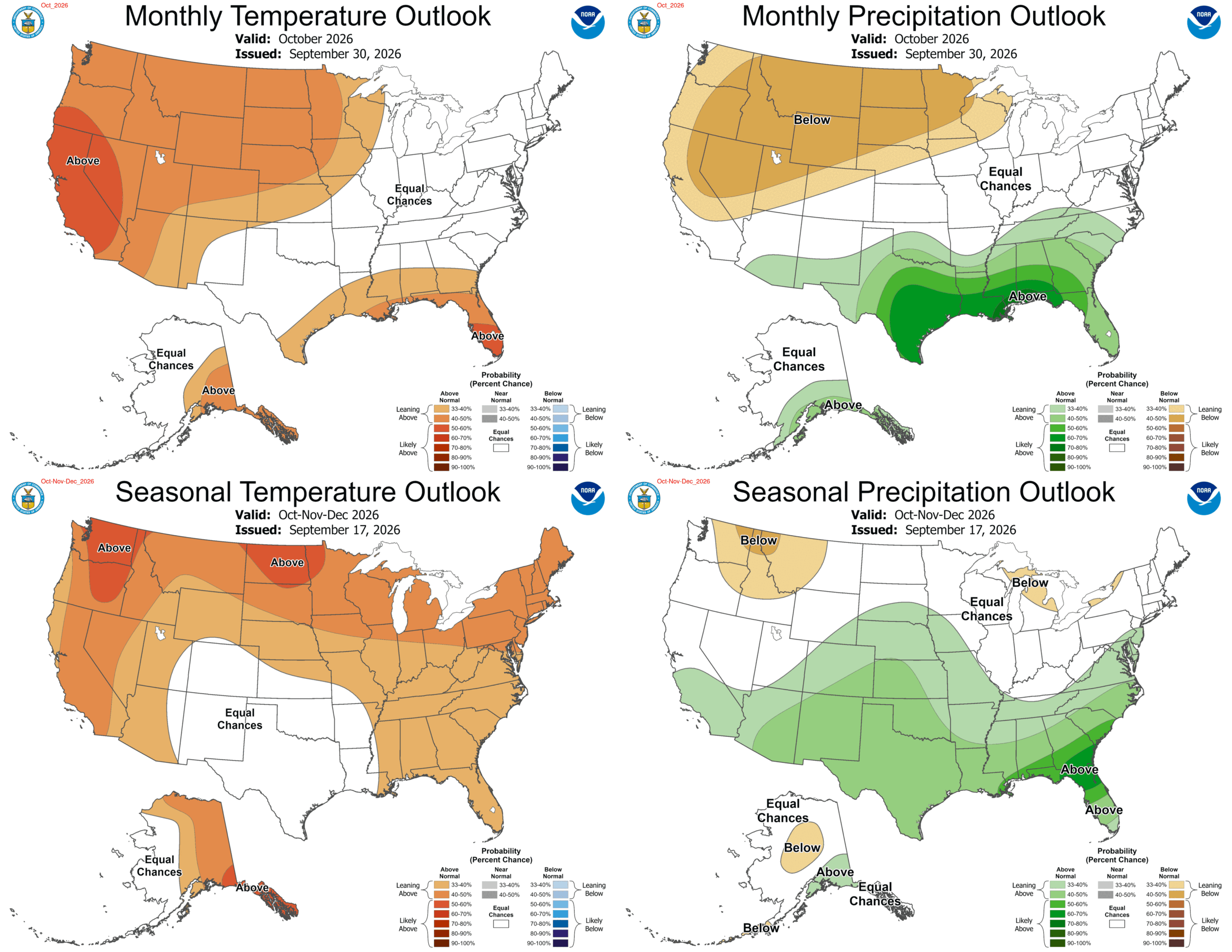
Figure 7 – Temperature (left panel) and precipitation (right panel) outlooks for the month of October (top panel) and October, November, and December (bottom panel) (Climate Prediction Center, climate.gov).