

Abacela Vintage 2026 – Véraison
Weather and Climate
- Regional/State Context: The western US saw temperatures 3.6°F above the 1991–2020 average for June through mid-August. Oregon specifically recorded its 3rd warmest period in 131 years (~4°F above average) and 9th driest year-to-date (71% of average precipitation).
- Southwestern Oregon Valleys: Tied for 9th warmest on record (+3.4°F). Precipitation is down 9+ inches (65% of normal, 9th lowest on record). Growing degree-days (GDD) are currently 10–18% above average, slightly behind 2025 and 10% below 2015 peak levels.
- Abacela Vineyard Conditions: Warm and dry, yet milder in extremes compared to recent years—only 1 day over 100°F (vs. 7–11 per year from 2021–2025). Only 0.67″ of rain was recorded since May 1st, featuring over 50 consecutive rain-free days (Figure 1).
Phenology
- Early Progress: Grapevine growth stages for budbreak and flowering in 2026 have been early (Figure 1). Fruit moved quickly through the lag phase (where cluster counts and berry weights were measured for yield forecasting).
- Véraison Timing: 50% véraison began July 31st (Tempranillo in Grand Hill & West Slope) and concluded by mid-August (Albariño and Merlot on August 17th).
- Long-Term Comparison: Across Abacela’s 11 long-term block/variety combinations:
- Average Véraison Date: August 9th (6 days earlier than average; tied with 2025).
- Budbreak to Véraison: 123 days (4 days shorter than average).
- Flowering to Véraison: 66 days (2 days longer than average).
- Harvest Outlook: Anticipated in 30 to 50 days from mid-August.
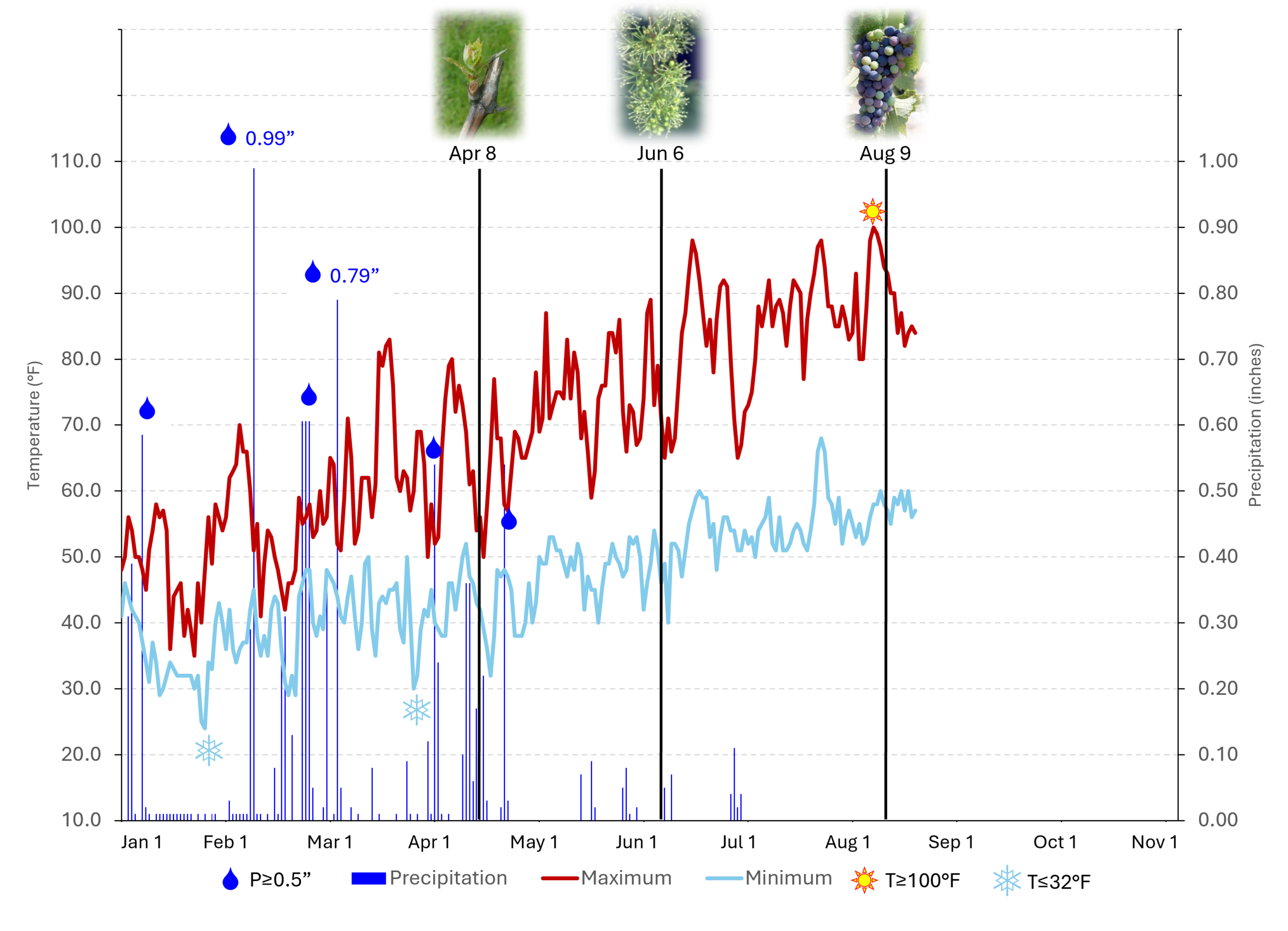 Figure 1 – Weather and phenological observations for Abacela from January through mid-August 2026. Daily maximum and minimum temperatures are shown in red and light blue, respectively, with temperatures above 100°F or below 32°F indicated by the yellow/red sun and ice crystal symbols, respectively. Daily precipitation is in a darker blue bar, with days receiving greater than 0.5” of rain indicated with a raindrop. The weather data comes from our main weather station on Cobblestone Hill. The phenological events and days between events come from an eleven variety/block combination of Tempranillo, Syrah, Malbec, Merlot, and Albariño.