

Abacela Vintage 2026 Summary
Weather and Climate
Early Spring & Frost (March – April)
- Early Growth: Warm, dry winter/early spring weather led to early vine growth in early March.
- Frost Events: Two frost events occurred on March 26–27 and April 17, resulting in variable impact—ranging from no damage in some vineyard blocks to moderate damage in others.
Early Growing Season (April – June)
- Temperatures: Temperatures averaged roughly 2°F above average, though without extreme heat (zero days over 90°F).
- Thermal Heat Units: Growing Degree Days (GDD) were 25% higher than the 1991–2020 average, tracking closely with the 2024 and 2025 vintages at the same point in the season.
- Precipitation: Early April brought the last significant rains of the vintage, but Abacela and the region remained below the long-term seasonal average.
Mid-Season & Summer (June – Mid-August)
- Regional Context: The western US saw temperatures 3.6°F above average. Oregon recorded its 3rd warmest June to August in 131 years (~4°F above average) and 9th driest year-to-date (71% of normal rain). The Southwestern Valleys tied for the 9th warmest (+3.4°F) with precipitation down over 9 inches (65% of normal).
- Milder Extremes at Abacela: Abacela experienced warm, dry conditions with fewer extreme heat spikes—recording only 1 day over 100°F (compared to an average of 7–11 days per year between 2021 and 2025).
Harvest Period & Ripening (September – October)
- Ripening & Weather: A cooler September slowed ripening for certain varieties, but negligible rain allowed harvest timing to be dictated by fruit readiness rather than storm pressure.
- Late Season Quality: Late September through the first ten days of October brought clear weather with warm days, cool nights, and no precipitation.
- Pest Pressure: High bird activity proved to be the main logistical challenge during harvest, requiring extra management to minimize fruit damage.
Full Season Overview (April 1 – October 9 Harvest End)
- Extreme Seasonal Drought: Over the 165 days from late April through the final pick on October 9, only 20 days recorded more than a trace of rain. Total precipitation reached 1.76 inches (60–80% below expected normal levels).
- Heat Units & Heat Stress: Overall seasonal temperatures finished close to the 15-year average with fewer days exceeding 95°F and no major heat stress events. Harvest ended on October 9 with 2760 GDD accumulated at the main weather station—above Abacela’s long-term average, though lower than the record-warm 2025 vintage.
Phenology
Abacela tracks phenology, important grapevine growth stages, by block and variety each year. The longest-term data that we have comes from eleven variety/block combinations, which include Tempranillo, Syrah, Malbec, Merlot, and Albariño. These observations started in 1997 for Tempranillo and Syrah, with the others added to the observations over time, with all eleven combinations observed since 2010. From these eleven variety/blocks long-term observations, the 2026 vintage phenology at Abacela is as follows and as shown in Figure 1.
- Budbreak averaged April 8th (two days earlier than our long-term average)
- Bloom averaged June 6th (six days earlier than our long-term average)
- Véraison averaged August 9th (six days earlier than our long-term average)
- Harvest averaged September 23rd (which was the same as the 2025 vintage and the earliest vintage across our main varieties)
Intervals between events from the eleven variety/block long-term observations include:
- Bud break to bloom was 57 days (6 days shorter than our long-term average)
- Bud break to véraison was 123 days (4 days shorter than our long-term average)
- Bud break to harvest was 167 days (11 days shorter than our long-term average)
- Bloom to véraison was 66 days (2 days longer than our long-term average)
- Bloom to harvest was 110 days (5 days shorter than our long-term average)
- Véraison to harvest was 44 days (7 days shorter than our long-term average)
All 16 varieties grown across our 25 blocks (Figure 2) have also been monitored since 2021 for phenology and provide a broad snapshot of vine growth and harvest timing. For all of our varieties, the 2026 vintage at Abacela saw the following:
Bud Break – Spring 2026 saw buds pushing during March 17-20. The earliest varieties and blocks to complete 50% budbreak were Albariño (Northeast block), Muscat (Grand Hill and Knoll blocks), Grenache (Angle and Grand West blocks), and Tinta Amarela (Grand Hill) on March 23rd. However, cooler weather followed, bringing a nip of frost and slowing down budbreak development across all of our other varieties. Tannat, a few blocks of Tempranillo, Listan Prieto, and Graciano finally reached 50% budbreak in the first week of May.
Bloom – We saw the first sign of flowering in the last week of May that accelerated over the next two weeks. The earliest varieties and blocks to complete 50% flowering were Albariño on June 1 (Northeast block) and Malbec on June 3 (East Hill block). Flowering proceeded over the following week with Tempranillo on June 10 (Knoll Block).
Véraison – Abacela experienced 50% véraison on July 31st with Tempranillo in the Grand Hill and West Slope blocks. Véraison continued across our varieties and blocks during the first two weeks of August with Albariño (North Slope) and Merlot (Central) reaching 50% on August 17th.
Harvest – started on September 9th with a couple of blocks of Albariño and West Slope Tempranillo coming in first. Harvesting continued over a 30-day period until the final picking on October 9th with Listan Prieto being picked last (very likely the most northerly commercial planting of this variety in the world).
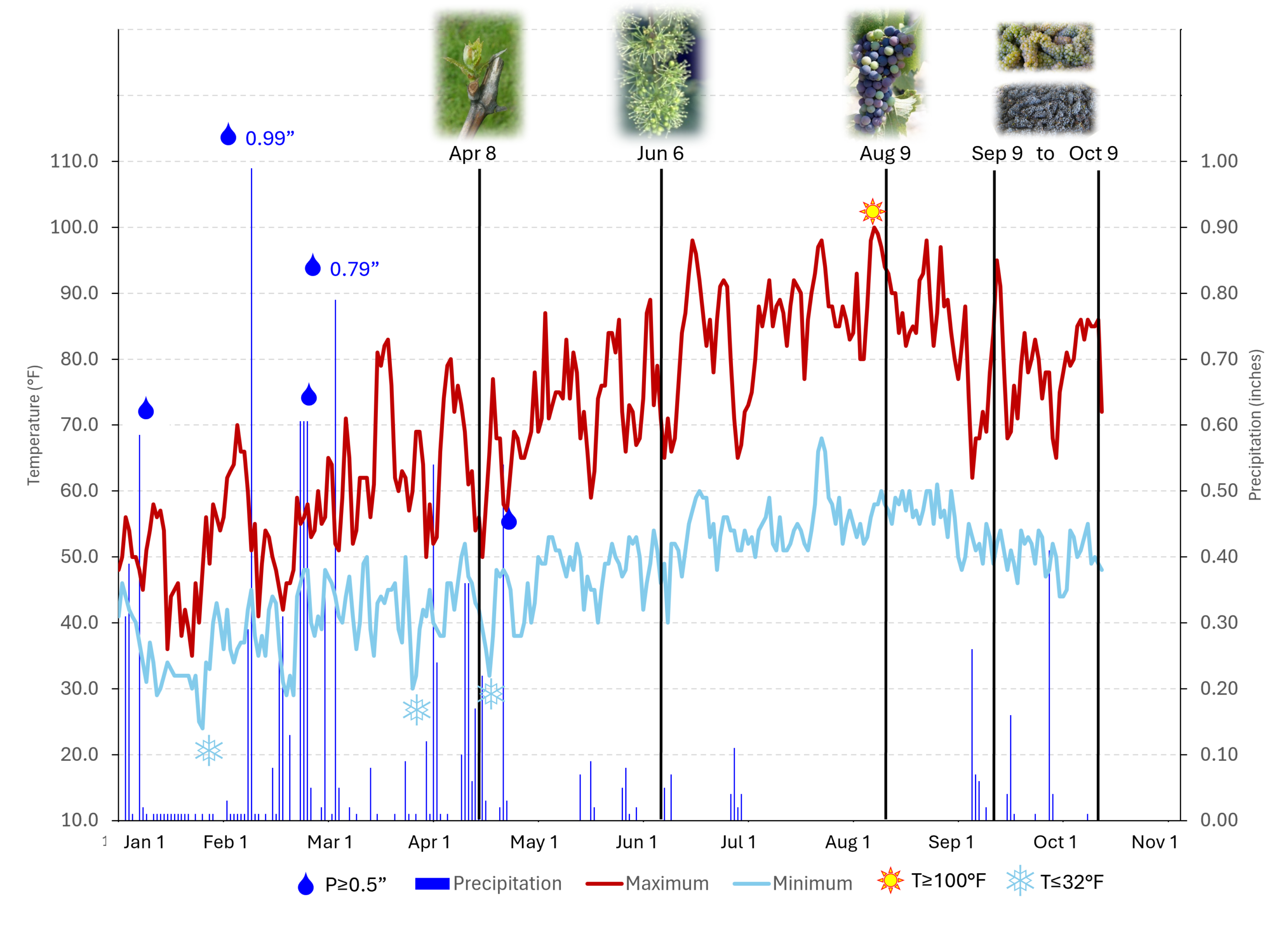 Figure 1 – Weather and phenological observations for Abacela from January through October 9, 2026. Daily maximum and minimum temperatures are shown in red and light blue, respectively, with temperatures above 100°F or below 32°F indicated by the yellow/red sun and ice crystal symbols, respectively. Daily precipitation is shown in a darker blue bar, with days receiving greater than 0.5” of rain indicated with a raindrop. The weather data comes from our main weather station on Cobblestone Hill. The phenological events and days between events come from an eleven variety/block combination of Tempranillo, Syrah, Malbec, Merlot, and Albariño.