

Abacela Vintage 2026 – Bud Break
Weather and Climate
The winter of 2025-2026 was exceptionally warm and dry over the western US, with temperatures 1-4 degrees above the average during 1991-2020. Oregon experienced its warmest November through March period over the last 131 years at 6.6°F above average. Precipitation during November through March was roughly 5 inches below average across Oregon, with snow water equivalents in the mountains ending the winter at one of the lowest levels ever recorded.
For the southwestern valleys of Oregon, including the Umpqua Valley, the winter was the second warmest at 5.4°F above average over the last 131 years. The winter months were one of the top 15 driest winters for the southwestern valleys, with a deficit of 11 inches, with most of the impact coming from less snowfall at higher elevations. February was the only month that saw slightly higher than normal precipitation, otherwise it was dry, dry, dry.
Since the first of the year, Abacela has experienced 9-10 inches of rain (Figure 1), 3-4 inches below the long-term average. Five days saw precipitation amounts greater than 0.5 inches, with the highest on February 8 at nearly 1 inch. Temperatures at Abacela have been warmer than average since January, with many days at 70 degrees or above, with the highest temperatures during mid-March of 82-83 degrees.
Phenology
Abacela tracks phenology, important grapevine growth stages, by block and variety each year. The longest term data that we have comes from eleven variety/block combinations, which include Tempranillo, Syrah, Malbec, Merlot, and Albariño. These observations started in 1997 for Tempranillo and Syrah, with the others added to the observations over time, with all eleven combinations observed since 2010.
The warm and dry winter created conditions where an early bud break was likely. We saw buds pushing soon after the 80 degree weather during March 17-20. The earliest varieties and blocks to complete 50% budbreak were Albariño (Northeast block), Muscat (Grand Hill and Knoll blocks), Grenache (Angle and Grand West blocks), and Tinta Amarela (Grand Hill) on March 23rd. However, cooler weather followed, bringing a nip of frost and slowing down budbreak development across all of our other varieties. Across our main long-term observations, the average budbreak in 2026 was April 8th (right at our average) but occurred over a 23-day window (Figure 1). The cooler weather from April 6-15 has slowed shoot growth somewhat, but the entire vineyard has now moved through budbreak.
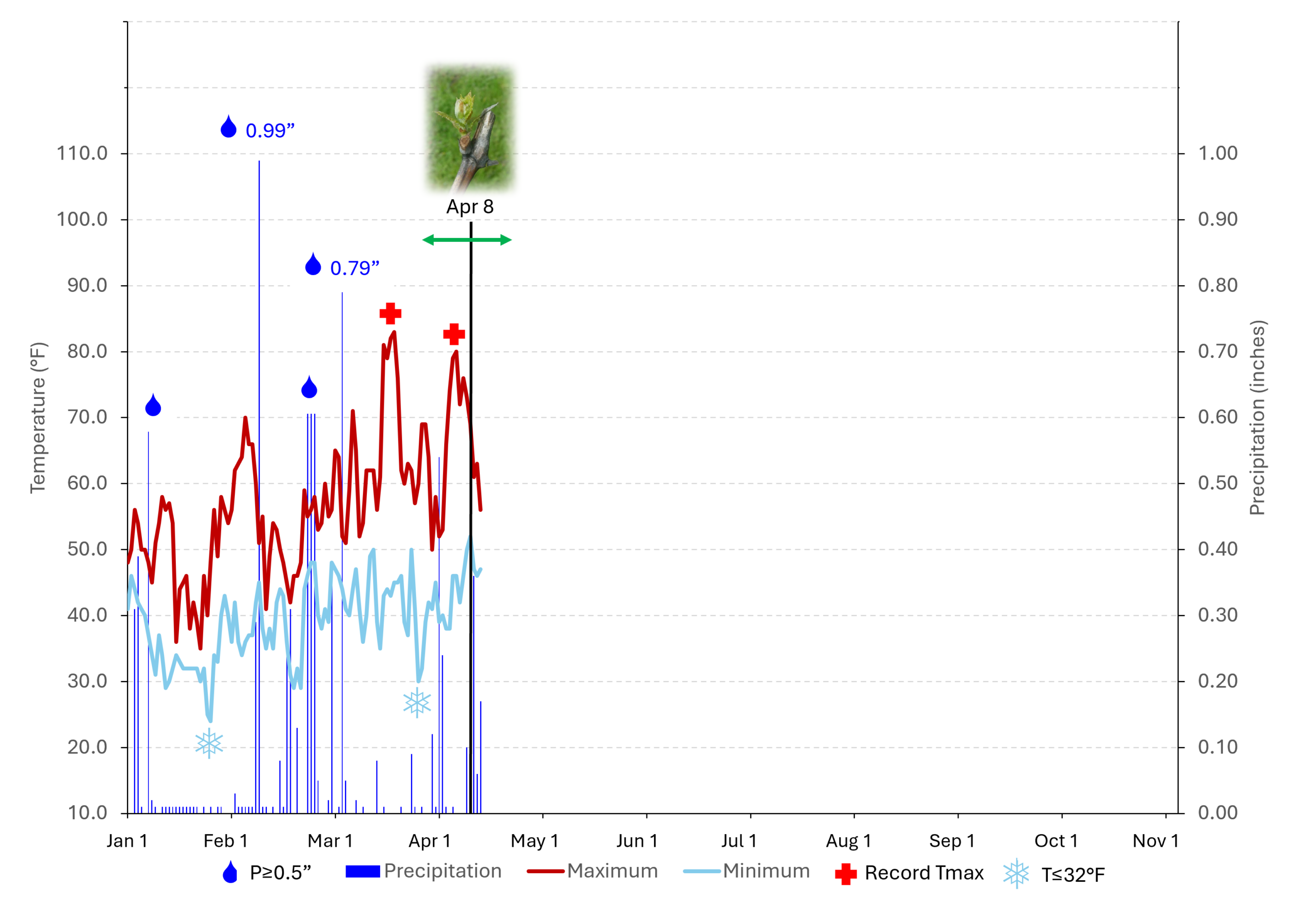
Figure 1 – Weather and phenological observations for Abacela from January through mid-April 2026. Daily maximum and minimum temperatures are shown in red and light blue, respectively, with record maximum temperatures or below 32°F indicated by the red cross and ice crystal symbols. Daily precipitation is in a darker blue bar, with days receiving greater than 0.5” of rain indicated with a raindrop. The weather data comes from our main weather station on Cobblestone Hill. The phenological events and days between events come from an eleven-variety/block combination of Tempranillo, Syrah, Malbec, Merlot, and Albariño.